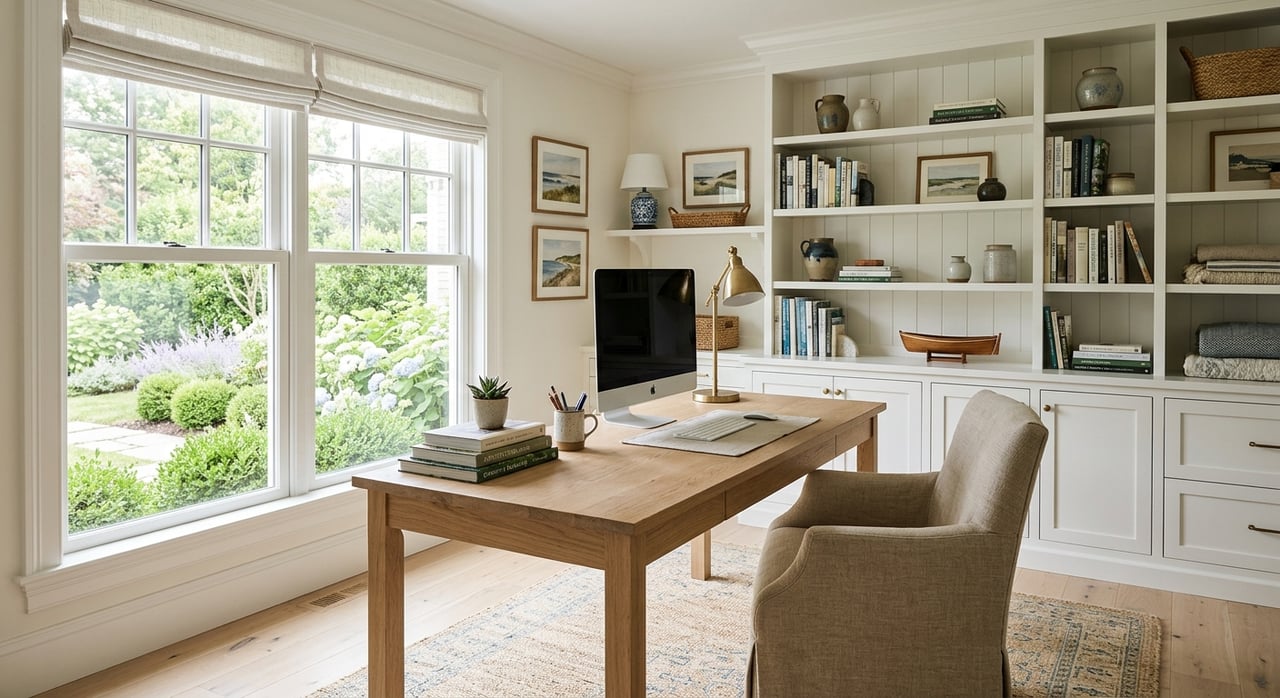
Need a home that works as hard as you do? In Westport, that goal is more realistic than ever, but finding the right work-from-home setup takes more than spotting a spare bedroom in the listing photos. If you want a house that supports video calls, focused work, and an occasional trip into the city, you need to weigh layout, light, noise, commute access, and local rules. Let’s dive in.
Why Westport Fits Hybrid Work
Westport is well suited to buyers who split time between home and office. The town describes itself as a live-work-play community with access to New York City, I-95, U.S. 1, the Merritt Parkway, two Metro-North stations, Amtrak, and a local commuter shuttle service.
That mix matters when you are not commuting five days a week but still need flexibility. Westport also offers a range of housing, from single-family homes on one- and two-acre lots to smaller in-town neighborhoods closer to downtown, which gives you different ways to balance privacy, space, and convenience.
The local numbers support that work-from-home appeal. Census QuickFacts estimates Westport’s population at 28,301 as of July 1, 2025, with an 88.8% owner-occupied rate, a median owner-occupied home value of $1,405,200, and a median household income above $250,000. It also reports that 98.5% of households have a broadband subscription, 99.2% have a computer, and the mean commute to work is 40.9 minutes.
Those stats tell you something important. In Westport, home office quality, internet reliability, and commute tradeoffs are not side issues. They are central parts of the buying decision.
What to Look for in a Home Office
A good work-from-home space is not always the biggest extra room in the house. In many cases, a smaller room with a door, manageable sound, and steady light will serve you better than a larger open area connected to the main living space.
Authoritative workplace guidance points to three core factors: noise, lighting, and temperature control. NIOSH recommends choosing a space where you can control those conditions, and OSHA advises setting up task lighting so it does not reflect on your screen. The U.S. Department of Energy also notes that daylighting depends on window size and location, with north-facing windows generally offering more even light and less glare than east- or west-facing windows.
That has a direct impact on how you shop for a house in Westport. Open kitchens, family rooms, and finished lower levels may look flexible on paper, but they can also come with foot traffic, TV noise, mechanical noise, and uneven light during the day.
Prioritize Privacy and Separation
If you take calls or need quiet blocks of time, look for a room with a real door. A dedicated office, den, or tucked-away bonus room often performs better than a desk in a wide-open great room.
When you tour a property, think beyond the staging. Ask yourself whether the room sits next to the kitchen, a laundry area, or a busy hallway, and whether that will still work on a full weekday.
Check Natural Light and Screen Glare
Natural light is a plus, but too much direct sun can become a problem fast. If a room gets strong east or west light, your screen may be harder to use at certain times of day.
A room with balanced daylight can be easier to work in for long stretches. Window placement, shade options, and your likely desk position all matter more than buyers sometimes expect.
Think About Temperature and Power
Comfort affects productivity. If a room runs too hot, too cold, or has limited outlets, the space may need work before it functions as a true office.
This is where practical property insight matters. Adding outlets, data lines, dedicated circuits, or new lighting is not just a cosmetic update. In Westport, those kinds of changes can involve permits and inspections under the Connecticut State Building Code.
Westport Layouts That May Work Well
Westport gives buyers a wide range of housing styles and settings. The town’s profile highlights primarily single-family homes, while its history references areas such as Bankside, Beachside, Coleytown, Compo, Green’s Farms, Long Lots, Old Hill, Saugatuck, Saugatuck Shores, and Westport Center.
For a hybrid worker, that variety can be useful. Some properties may offer more lot space, separation, and renovation flexibility, while others may offer easier access to downtown, transit, and daily errands.
More Space Versus More Convenience
If you want a private office, larger lot settings may give you more options for a dedicated room, expansion, or a reworked lower level. If you care about getting to the train easily a few times each week, an in-town location or a property with easier station access may be more appealing.
This is not just about distance on a map. It is about how your daily routine actually works, from school drop-offs to Zoom calls to catching an evening train.
Transit Still Matters in a Hybrid Schedule
Westport and Greens Farms are the town’s main commuter rail stops. The Westport Transit District also operates Wheels2U, which provides $2 shared rides between the Westport and Greens Farms stations and any Westport address.
If you go into the office part-time, it is worth evaluating the full route, not just the house itself. A great office at home feels even better when your station access is simple on the days you need it.
Personal Office or Home Business?
This is one of the biggest distinctions buyers should understand before they close. A room used as your personal office is different from a space used for a business with clients, employees, or frequent visits.
Westport’s current Zoning and Subdivision Regulations were last revised on April 12, 2024. Under those regulations, a Home Occupation, Level 1 is allowed only in the principal building on the lot and requires a zoning permit.
Key Westport Home Occupation Rules
If you plan to run a business from home, some of the rules include:
- The use must be incidental and clearly secondary to the residence
- It may use no more than 25% of the principal building’s floor area, excluding cellars and basements
- It allows no more than ten patron, client, or associate visits per day
- It allows no more than one non-resident on-site employee or contractor
- It cannot have a visible display from outside
- Only one small sign is allowed
Level 2 home occupations require special permit and site plan approval and are more restrictive in practice. Westport also permits only one Level 1 or Level 2 home occupation per lot.
Why Property Type Matters
Not every home type works the same way if your office will also support your business. Westport’s Level 1 and Level 2 home occupation rules prohibit these uses in multiple-family dwelling units.
That means a condo or multifamily property may not offer the same flexibility as a detached single-family house if your plan includes client-facing work or on-site business activity. If your office use is purely personal, that is a different conversation, but you still want to understand the property’s layout and any building limitations.
Renovation Plans Need a Closer Look
A lot of buyers are open to making updates after closing, especially if the house checks most of the boxes. In Westport, that can be a smart strategy, but work-from-home improvements should be viewed with both function and approvals in mind.
Westport’s Building Department reviews architectural, structural, mechanical, electrical, plumbing, alarm, sprinkler, and ADA plans, issues permits, and handles inspections. So if you are considering a lower-level office, extra lighting, added power, or a more substantial renovation, those upgrades may require more than a contractor quote.
Lower Levels and Bonus Rooms
A finished basement or lower level can be a strong office option, but you should verify how the space was improved and what constraints apply. Buyers should check zoning, floodplain, and building-code implications before assuming a lower level can be used or upgraded exactly as planned.
That is especially important in a town like Westport, where flood zone status can affect what is practical at a given property. The town’s guidance tells applicants to confirm flood zone, wetlands, sewer or septic status, and zoning details before applying for permits.
Detached Studios Are Not Automatic
Some buyers picture a detached office or backyard studio for maximum privacy. In Westport, that is not something you should assume is allowed for business use.
Home occupations are generally required to be in the principal building, with limited exceptions tied to certain historic accessory-structure rules. If detached workspace is part of your plan, you will want to confirm what the current regulations allow before you count on it.
Flex Space Versus Future Apartment
A room that works as an office today may look like a future guest suite, in-law setup, or separate unit tomorrow. In Westport, that future use can trigger a very different approval path.
The town permits one accessory dwelling unit per lot and allows a single-family home to be converted to add one accessory apartment, subject to zoning permit approval. Current standards cap the accessory apartment at 1,500 square feet or 25% of the dwelling’s total floor area, whichever is smaller, and require at least three off-street parking spaces plus sewer or septic approval.
Accessory buildings also come with limits. Under the current regulations, cellars, basements, and crawl spaces in accessory buildings must remain unfinished and may not be used as living space.
A Smart Westport Buyer Checklist
When you are comparing homes in Westport, it helps to evaluate work-from-home space the same way you would evaluate a kitchen or roof. Here is a practical checklist to bring into your search:
- Is there a room with door separation for focused work?
- How does the room handle natural light and screen glare?
- Is the office near kitchens, play areas, laundry, or mechanical systems?
- Are broadband, outlets, and power setup likely to support your needs?
- Will the space be for personal office use only, or for a business subject to home occupation rules?
- Is the property in a flood zone, on sewer or septic, or in a historic or village overlay district?
- If you want to renovate, has the space likely been permitted properly?
- If you are considering a lower level or detached structure, what legal and practical limits apply?
- How easy is the trip to Westport or Greens Farms station on the days you commute?
A strong buying strategy looks at both daily function and long-term flexibility. That is especially true in a market where space, zoning, and property condition can all shape how useful a home really is.
Why Local Guidance Helps
Buying a work-from-home house in Westport is not just about square footage. It is about choosing a property where layout, condition, location, and town rules all line up with the way you actually live and work.
That is where local knowledge and construction-aware guidance can save you time and money. If you are weighing whether a lower level can be improved, whether a room is truly quiet enough, or whether a property fits your commute rhythm, practical insight matters.
If you are looking for a Westport home with space to work from home, Robbie Salvatore can help you evaluate properties with a sharper eye and a more informed plan.
FAQs
What should you look for in a Westport work-from-home office?
- Look for a room with a door, manageable noise, good natural light, limited screen glare, comfortable temperature control, and enough power and internet access for your daily work.
Can you run a business from a Westport home office?
- Possibly, but Westport home occupation rules may apply if the space is used for business activity, client visits, employees, or contractors, and a zoning permit may be required.
Can a condo or multifamily property in Westport be used for a home occupation?
- Westport’s Level 1 and Level 2 home occupation rules prohibit those uses in multiple-family dwelling units.
Can a finished basement in Westport become a home office?
- It may be possible, but you should verify zoning, building-code, and floodplain considerations before assuming the lower level can be used or renovated as planned.
Can you build a detached office or studio in Westport?
- Not automatically, because home occupations are generally required to be in the principal building, with only limited exceptions tied to certain historic accessory-structure rules.
Why does station access matter for Westport hybrid workers?
- Westport and Greens Farms stations serve part-time commuters, and easier access to either station, plus Wheels2U shared rides, can make a hybrid schedule more practical.